
Partner, Lanier Meyer McBride Blair LLP | Best-Selling Author | Advocate
Research on Child Sexual Abuse in Youth-Serving Organizations
Evidence that explains how abuse actually happens in youth programs and what real prevention requires.
This page gathers key studies and government reports that shape Jeff Meyer’s work on prevention in youth-serving organizations. Each entry includes a short, plain-language overview and links to the original article. Summaries are written to be useful for parents, youth-organization leaders, journalists, policymakers, and advocates, and they avoid graphic detail.
How this research can help you:
• Parents & caregivers – understand patterns so you can ask better questions and push for safer policies.
• Youth-serving organizations – translate research into supervision, screening, and reporting structures that work in practice.
• Journalists & policymakers – quickly find reliable data and context you can quote accurately.
Content note: Summaries mention abuse in general terms but avoid graphic detail.
“After they’re caught, only about 1 in 4 institutional offenders say abuse had nothing to do with why they chose their role.”
Read that again—because it changes prevention.
If we keep designing safeguards for “rare accidents,” we will keep missing the fact that youth-serving organizations are a magnet for one of the most dangerous predators of children.
Source: In the cited UK sample summarized by the Australian Institute of Criminology, 25% said abuse had ‘nothing to do’ with their motivation; 15% ‘specifically chose’ the role to abuse; 42% said it was ‘at least part’; 20% were unsure.” Australian Institute of Criminology

Most YSO predators abuse dozens of victims before being caught.
Targeting is patterned, not random.
The vast majority of predators are known and trusted by the victim and their family.
Child Sexual Abuse and Boundary Violating Behaviors in Youth Serving Organizations: National Prevalence and Distribution by Organizational Type (2024)
Authors: Assini-Meytin, McPhail, Sun, Mathews, Kaufman, Letourneau
This study used a large, nationally representative U.S. sample of young adults to estimate how often child sexual abuse and boundary-violating behaviors occur in youth-serving organizations such as schools, sports, religious groups, arts programs, and “Big 6” national organizations. It found that a measurable share of respondents had experienced abuse in YSO settings, and that non-sexual boundary violations (for example, unsupervised one-on-one time or special favors) were much more common than legally defined abuse. The authors compare risks across setting types and age cohorts, with some evidence of improvement in certain large organizations.
Key takeaways for prevention
Abuse in youth-serving organizations is not rare and appears across many types of programs, with schools and sports settings particularly important.
Everyday boundary violations are far more common than formally recognized abuse and should be treated as early warning signs and prevention targets.
Sexual Abuse and Assault in a Large National Sample of Children and Adolescents (approx. 2020–2021)
Authors: Gewirtz-Meydan, Finkelhor
Using a nationally representative U.S. sample of 13,052 children and adolescents (ages 0–17) drawn from several waves of the National Survey of Children’s Exposure to Violence, this study examined how sexual abuse and assault actually look in practice: who the offenders are, where incidents occur, and whether adults or authorities ever find out. Most offenses against both boys and girls were committed by other juveniles, usually acquaintances. A majority of incidents were never reported to parents or other adults, and only a small fraction ever reached police.
Key takeaways for prevention
Most child sexual abuse is committed by other juveniles known to the victim, not by strangers, which means prevention must focus on peer and acquaintance dynamics.
Two-thirds of incidents are never disclosed to adults, so reported cases reflect only a portion of what children experience.
National Survey of Children’s Exposure to Violence (NatSCEV I) – Final Report (2014)
Authors: University of New Hampshire (Finkelhor and colleagues)
This final report describes the first National Survey of Children’s Exposure to Violence (NatSCEV), a large U.S. telephone survey measuring how often children and adolescents experience or witness many forms of violence, including sexual abuse, peer victimization, maltreatment, and exposure to domestic or community violence. The report presents lifetime and past-year rates across age groups and settings, showing that most children experience some form of direct or indirect victimization. These findings underpin much of the current understanding that violence exposure is common rather than exceptional.
Key takeaways for prevention
Exposure to violence, including sexual victimization, is widespread across childhood, not limited to a small “high-risk” group.
Prevention and response efforts should be built into everyday systems (schools, health care, youth programs) rather than reserved only for extreme or rare situations.
Child and Youth Victimization Known to Police, School, and Medical Authorities (2012)
Authors: Finkelhor, Ormrod, Turner, Hamby
Using NatSCEV data, this report asks a simple question: when children are victimized, how often do key authorities actually know about it? The authors compare children’s self-reported victimization with whether police, school officials, or medical professionals were aware of any incidents. Only a minority of victimized children had even one event known to these authorities; school personnel knew more than police or medical professionals, but many serious incidents still never reached any system. Knowledge varied by offense type, with severe incidents somewhat more likely to be noticed.
Key takeaways for prevention
System awareness is a late-stage and incomplete signal; many children’s victimizations are never known to police, schools, or health professionals.
Relying on reports or official cases to identify problems severely underestimates the true level of harm and delays prevention.
Child Sexual Abuse in Youth-Oriented Organisations: Tapping into Situational Crime Prevention from the Offender’s Perspective (2015)
Authors: Leclerc, Feakes, Cale
This study interviewed 23 Canadian adults who sexually offended in youth-oriented organizations, such as schools and youth programs, to understand how they gained access to children and how organizational conditions shaped offending. Many offenders had long tenures in institutions, sometimes spanning years before detection. They frequently described exploiting unsupervised one-on-one time, off-site activities, and ambiguity in roles or policies. The paper applies situational crime prevention concepts to show how small changes in routines and supervision could have disrupted their offending.
Key takeaways for prevention
Once embedded in youth organizations, offenders can have years of opportunity before being detected, especially when supervision and oversight are weak.
Practical changes—restricting unsupervised contact, monitoring off-site activities, and clarifying rules—can significantly reduce opportunity for abuse.
Adult Sex Offenders in Youth-Oriented Institutions: Evidence on Sexual Victimisation Experiences of Offenders and Their Offending Patterns (approx. 2012)
Authors: Leclerc, Cale
Drawing again on 23 convicted Canadian offenders who worked or volunteered in youth-oriented institutions, this Trends & Issues paper looks closely at their backgrounds and offending patterns. On average, offenders had been involved with institutions for over 16 years before being caught. Initial estimates of around 15 victims per offender rose to nearly 48 during treatment as disclosure became more complete. Most had no prior criminal conviction for child sexual abuse, and many assaults occurred off-site, after relationships with children were extended beyond formal program activities.
Key takeaways for prevention
Long institutional tenure, multiple victims, and off-site contact are common in known cases, underscoring the need for ongoing monitoring rather than one-time screening.
Because most offenders lacked a prior conviction, background checks alone are not a sufficient safety strategy.
Educator Sexual Misconduct: A Synthesis of Existing Literature (2004)
Author: Shakeshaft
Commissioned by the U.S. Department of Education, this report reviews existing research on sexual misconduct by school personnel, including teachers and other adults in K–12 settings. It synthesizes prevalence estimates from student surveys, case studies, and administrative data. Some studies suggest that nearly 1 in 10 students experience some form of unwanted sexual attention or misconduct from an educator before graduating. The report also identifies patterns in risk factors, institutional responses, and reporting obstacles within school systems.
Key takeaways for prevention
Sexual misconduct by educators appears more common than many parents and schools assume, and is not limited to highly publicized cases.
Schools need clear policies, accountability, and training that address staff–student boundaries and create safe reporting pathways.
A Comparative Study of Demographic Data Relating to Intra- and Extra-Familial Child Sexual Abusers and Professional Perpetrators (2004)
Authors: Sullivan, Beech
This study compares three groups of adult men who sexually abused children: intra-familial offenders, extra-familial offenders, and “professional perpetrators” who abused children they worked with in professional roles (for example, clergy, teachers, or care staff). Forty-one professional perpetrators were examined in detail. They were more likely to report sexual interest in same-sex children, and most had already offended against children by early adulthood. Many arranged meetings with children outside work specifically to facilitate abuse, and a substantial proportion had experienced sexual victimization themselves.
Key takeaways for prevention
Professional perpetrators often blur work and non-work boundaries, arranging contact with children outside formal settings, which should be tightly controlled.
Screening and supervision policies must consider patterns of opportunity and boundary-crossing, not just demographic characteristics or criminal history.
Misperceptions About Child Sex Offenders (approx. 2011)
Author: Richards
This Australian Trends & Issues paper reviews research on who child sex offenders actually are, and compares the evidence with common public stereotypes. It summarizes prevalence data on child sexual abuse and offender characteristics, highlighting that most offenders are known to the child (family members, acquaintances, or authority figures), that very few incidents involve strangers, and that many offenders have no prior convictions. The paper warns that focusing on sensationalized “stranger danger” images can distract from the more typical patterns of abuse.
Key takeaways for prevention
Public narratives that focus on unknown, visibly “deviant” strangers mislead parents and organizations about where the real risk lies.
Effective prevention requires recognizing that most abuse is committed by people in the child’s existing network, including trusted adults.
Recidivism of Sex Offenders (2001)
Author: Center for Sex Offender Management (CSOM)
This policy brief summarizes research on how often convicted sex offenders are rearrested or reconvicted for new crimes. It reviews multiple studies and explains how different definitions of “recidivism” (new arrest, new conviction, parole violation) produce different numbers. Across one influential synthesis, sex offense reconviction rates over long follow-up periods were around 13–19 percent for different offender groups, while overall reoffending for any crime was much higher. The paper emphasizes that recidivism is real but lower than many people assume, and that management and treatment matter.
Key takeaways for prevention
Sex offense recidivism is significant but not universal, and must be interpreted carefully based on how follow-up and definitions are handled.
Policy decisions should focus on effective supervision and risk management rather than assuming all offenders will inevitably reoffend.
Inverted Reality is when we trust the system… predators exploit it.

What We Assume
“If we do background checks, we’re safe.”
“It’s rare.”
“It’s one kid, one time.”
What The Data Shows
Almost all offenders have no prior conviction before institutional offending shows up.
The CDC’s current summary: at least 1 in 4 girls and 1 in 20 boys experience CSA—and ~90% is perpetrated by someone known/trusted.
When abuse happens in institutions, offender disclosures can involve dozens of victims before the predator is caught.
3.75% of the population report experiencing sexual abuse at a youth-serving organization, not grooming, but actual physical sexual abuse. And the actual rates of abuse may be even higher.

Victim counts like “21–48” are disclosure-based and can rise over time (e.g., assessment → treatment). They reflect what offenders disclosed, not an upper bound.

Meet Jeffrey D. Meyer
Jeff Meyer is a partner at Lanier Meyer McBride Blair LLP, where he represents survivors of sexual abuse and assault, holding institutions accountable for preventable harm.
He’s the author of Inverted Reality, which challenges the “notice/red flag” framework and argues for structural prevention in youth organizations.
“Sexual abuse cases are, for the most part, negligence cases—and in youth‑serving organizations that means prevention is a design problem.” — Jeff
Partner, Lanier Meyer McBride Blair LLP (national firm focused on representing survivors of sexual abuse and assault; survivor-centered / trauma-informed)
Author: Inverted Reality (written to shift the conversation from “notice” to primary prevention)
Media-ready: brings the research, real case experience, and clear language for general audiences
“If you’re a survivor, a parent, or a journalist trying to understand what institutions keep getting wrong—this is the conversation we need to have.”
A Guest Who Can Explain the Data Without Sanitizing the Stakes.

What your audience will take away
Why “background check prevention” fails when many offenders have no record before first detection Australian Institute of Criminology
Why targeting is patterned (sexual knowledge cues + vulnerability cues) Australian Institute of Criminology+1
Why victim counts can explode as disclosure becomes complete Australian Institute of Criminology+1
What real prevention looks like: policies that remove privacy, isolate grooming channels, and enforce supervision (the “environment design” approach)
Jeff Meyer Wrote The
Book on Ending Child Sex Abuse at
Youth Serving Organizations
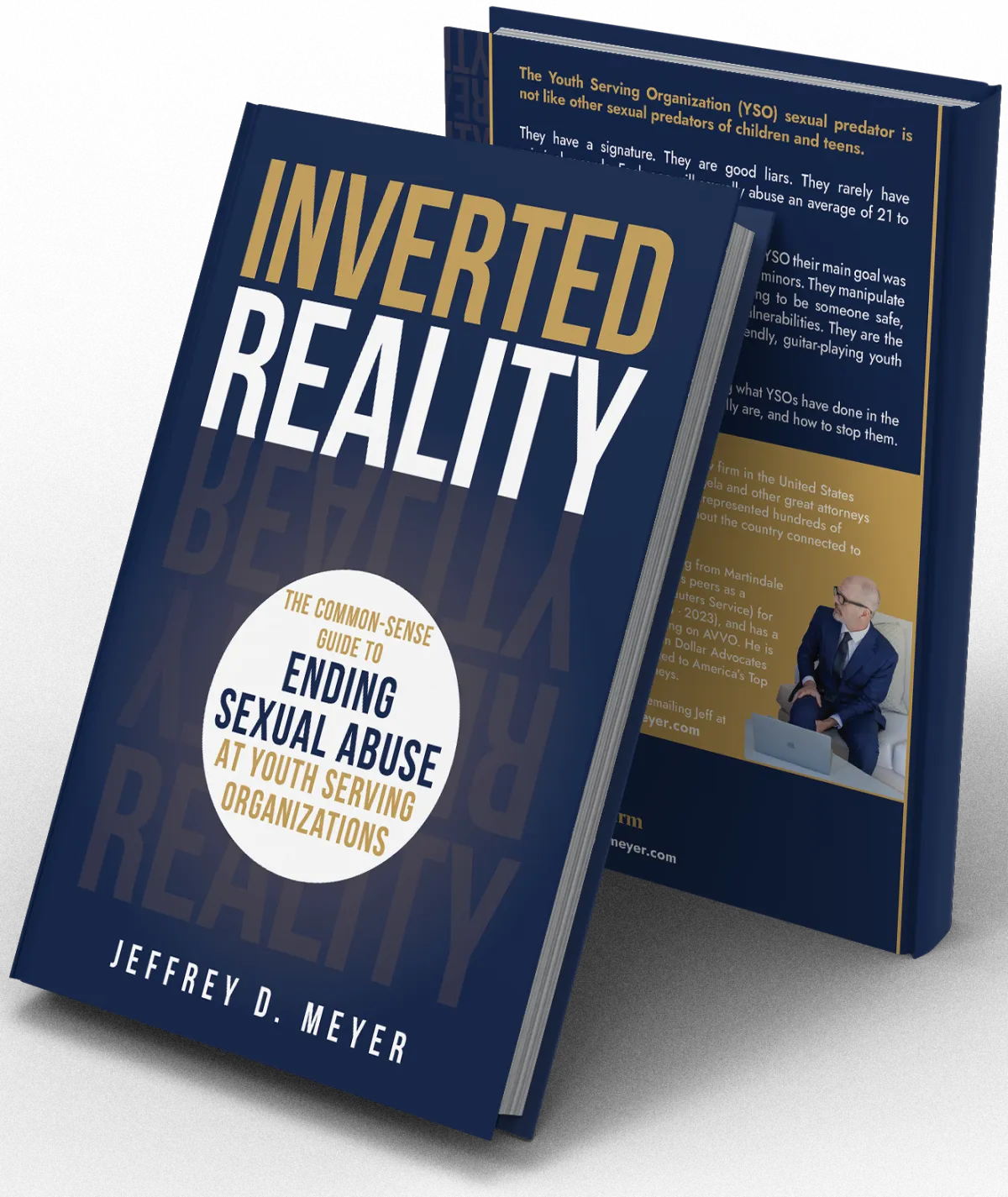
Inverted
Reality
By Jeffrey D. Meyer
A Revolutionary Guide To Protecting Children And Teens From Sexual Abuse At Schools, Religious Organizations, Camps, Sports Teams And Other Youth Serving Organizations. Written by one of our law partners.

1
Amazon New Release in Personal Injury Law

1
Amazon New Release in Personal Injury Law
1
Amazon New Release in Personal Injury Law
A Guest Who Can Explain the Data Without Sanitizing the Stakes.
What your audience will take away
Why “background check prevention” fails when many offenders have no record before first detection Australian Institute of Criminology
Why targeting is patterned (sexual knowledge cues + vulnerability cues) Australian Institute of Criminology+1
Why victim counts can explode as disclosure becomes complete Australian Institute of Criminology+1
What real prevention looks like: policies that remove privacy, isolate grooming channels, and enforce supervision (the “environment design” approach)
They Hid the Truth. We Uncover It.
When institutions minimize risk, survivors pay the price.
Lanier Meyer McBride Blair LLP was built to pursue these cases with survivor-centered, trial-ready standards. Glassdoor+1
Jeffrey D. Meyer
FOLLOW JEFF


SOURCES
AIC Trends & Issues paper summarizing institutional offender motivation distribution and disclosure-based victim counts Australian Institute of Criminology
AIC study reporting 492 victims across 23 offenders and selection indicators Australian Institute of Criminology
CDC “About Child Sexual Abuse” (May 16, 2024) CDC
2024 nationally representative YSO-context prevalence paper (Assini‑Meytin et al.) safekidsthrive.org+2safekidsthrive.org+2
FOR MEDIA
FOR READERS
FOR SURVIVORS
Jeffrey D. Meyer is licensed to practice law only in Arizona. His law firm has lawyers licensed in other states; please see www.lmmblaw.com for details about other lawyers and their jurisdictions.
Copyright 2026. Jeffrey D. Meyer. All Rights Reserved.
Jeffrey D. Meyer
FOLLOW JEFF
FOR MEDIA
FOR READERS
FOR SURVIVORS
SOURCES
AIC Trends & Issues paper summarizing institutional offender motivation distribution and disclosure-based victim counts Australian Institute of Criminology
AIC study reporting 492 victims across 23 offenders and selection indicators Australian Institute of Criminology
CDC “About Child Sexual Abuse” (May 16, 2024) CDC
2024 nationally representative YSO-context prevalence paper (Assini‑Meytin et al.) safekidsthrive.org+2safekidsthrive.org+2
Copyright 2026. Jeffrey Donald Meyer. All Rights Reserved.